People
Building a clear path for designer growth
A career framework for design, and a lightweight evaluation tool that saved around 24 hours per person a year and was adopted across Cuvva.
In brief
Cuvva’s design roles had vague job descriptions and no clear route to progress, and the company’s evaluation process took people days. I built a career framework for design, then a Google Sheets evaluation tool that I took company-wide through a hack week.
Outcome90% of staff adopted the tool, saving around 24 hours per person a year, the equivalent of one full-time role. Clearer, fuller job descriptions also led to higher design salaries across the board.
Context
When I joined Cuvva, the job descriptions for design roles, including my own, were vague and lacked depth. They listed responsibilities and skills, but without real substance. More importantly, designers had no clear way to show their progression or track their career growth.
This wasn’t unique to design. Other departments had the same problem, so career development was unclear across the business.

The challenge
- In 1:1s my team often asked about progression, but there was no framework or job descriptions for different levels to guide them.
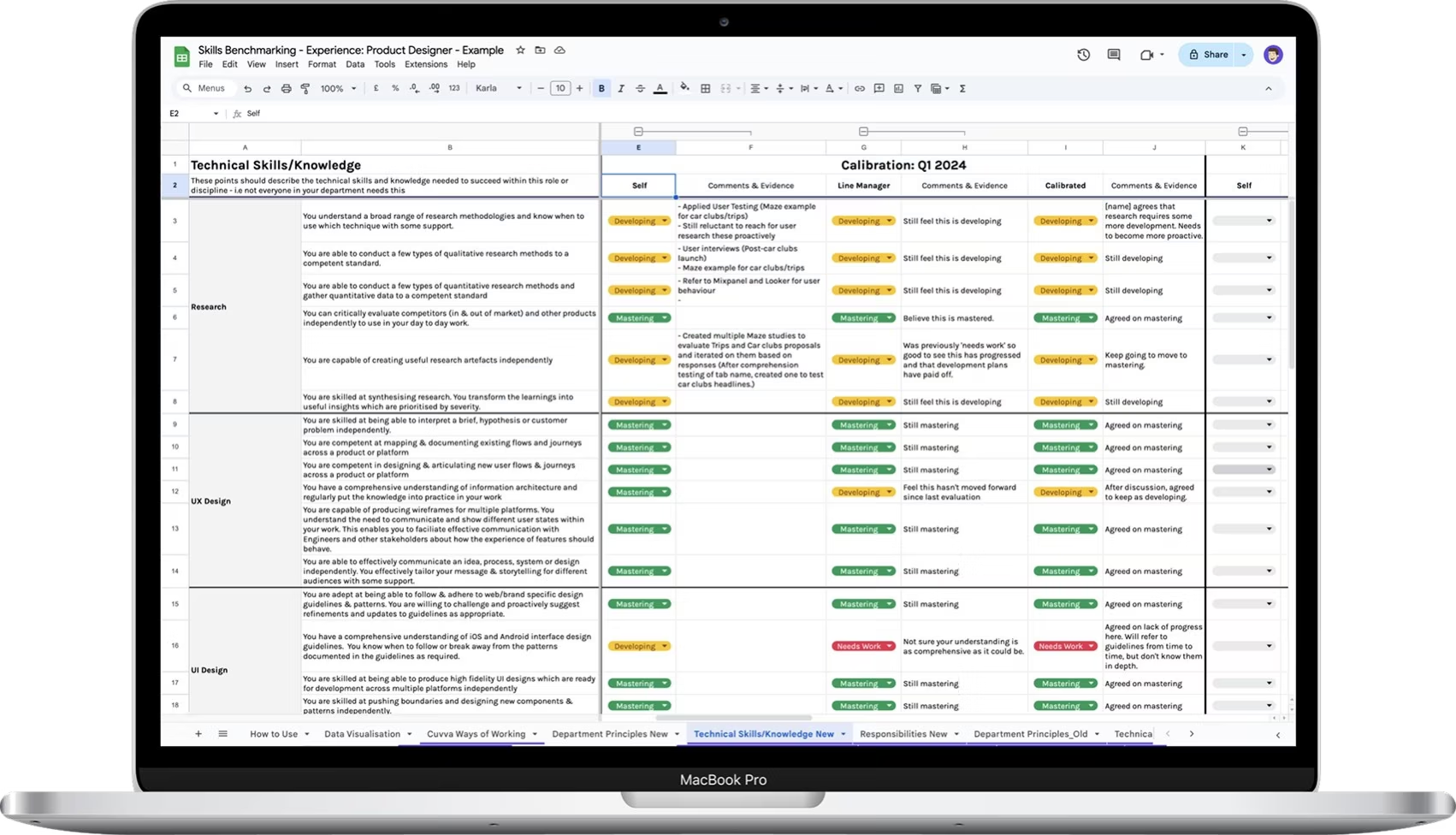
- The company had a twice-yearly evaluation process, but it was inefficient: multiple Word documents for each person, with comments used to track progress.
- Many people found it time-consuming, and some said evaluations took them days to complete.
- Line managers, me included, found the process frustrating, especially with several direct reports.
- The People team spent a lot of time manually tracking performance with a traffic light system.
- With around 100 people, Cuvva didn’t have the budget for dedicated tools to simplify any of this.
What I did
1A career framework for design
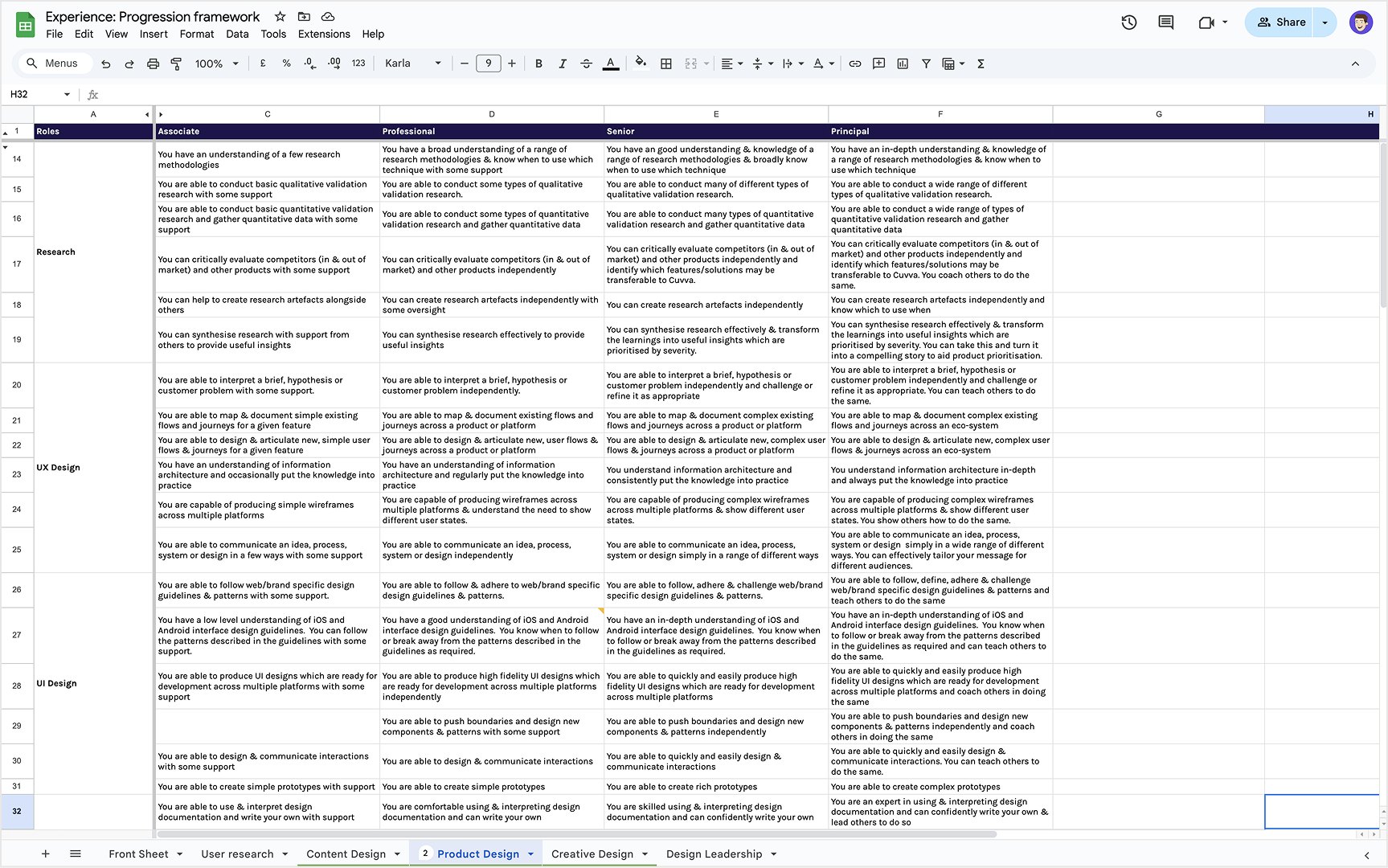
I created a career framework for design roles at Cuvva.
- I ran research and reviewed internal job evaluations to define career levels that suited both our current size and our future scaling needs.
- I worked with my team to describe what “good” looked like at each level, and built a structure that highlighted core skills and development opportunities.
- I partnered with the People team so the framework fitted the company’s wider evaluation process.
Rich played an instrumental role in creating bespoke People processes tailored to the unique needs of his team, ensuring every initiative felt purposeful and impactful.
2From framework to tool
The team responded well to the framework, but found it more time-consuming to complete the first time round.
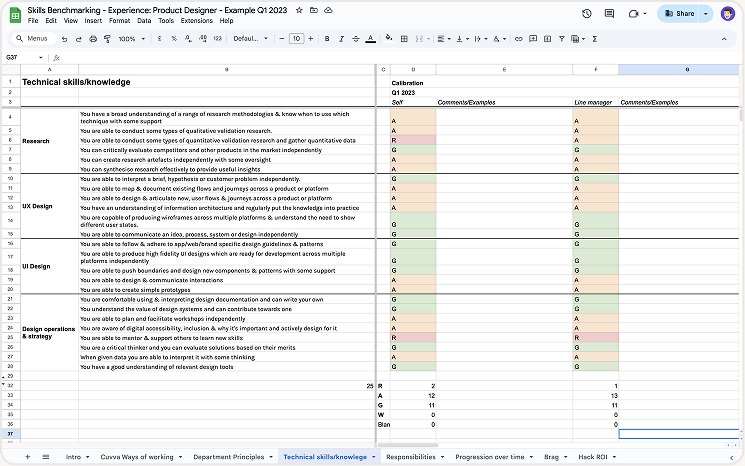
- To make it more efficient, I built a prototype evaluation tool in Google Sheets for my team.
- Feedback was overwhelmingly positive. The tool was quicker and easier to use, auto-calculated scores saved time, and it was easy to look back at previous comments.
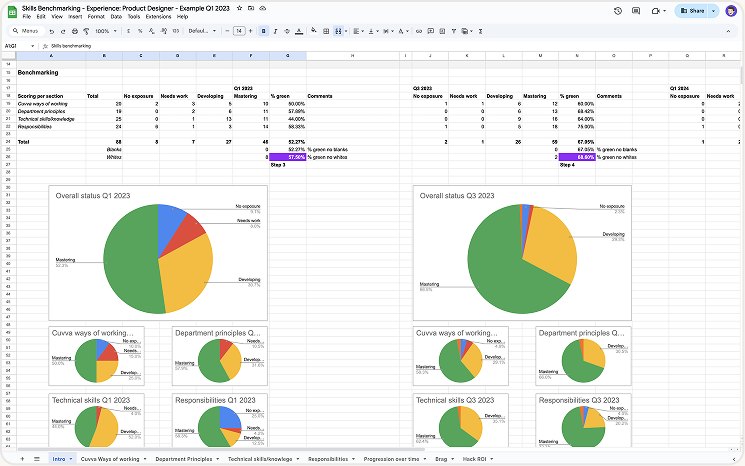
During the company hack week in Q1 2023, I led a cross-functional team from Engineering, People and Ops to:
- research and validate our assumptions
- refine the prototype and roll it out across the organisation
- improve how it looked and add features to make it easier to use
This improved the evaluation process and built broad support for the changes, which were then adopted across the company.
Results
Around 24 hours saved per person a year, a tool most of the company adopted, and a clearer path to progression and higher pay for designers.
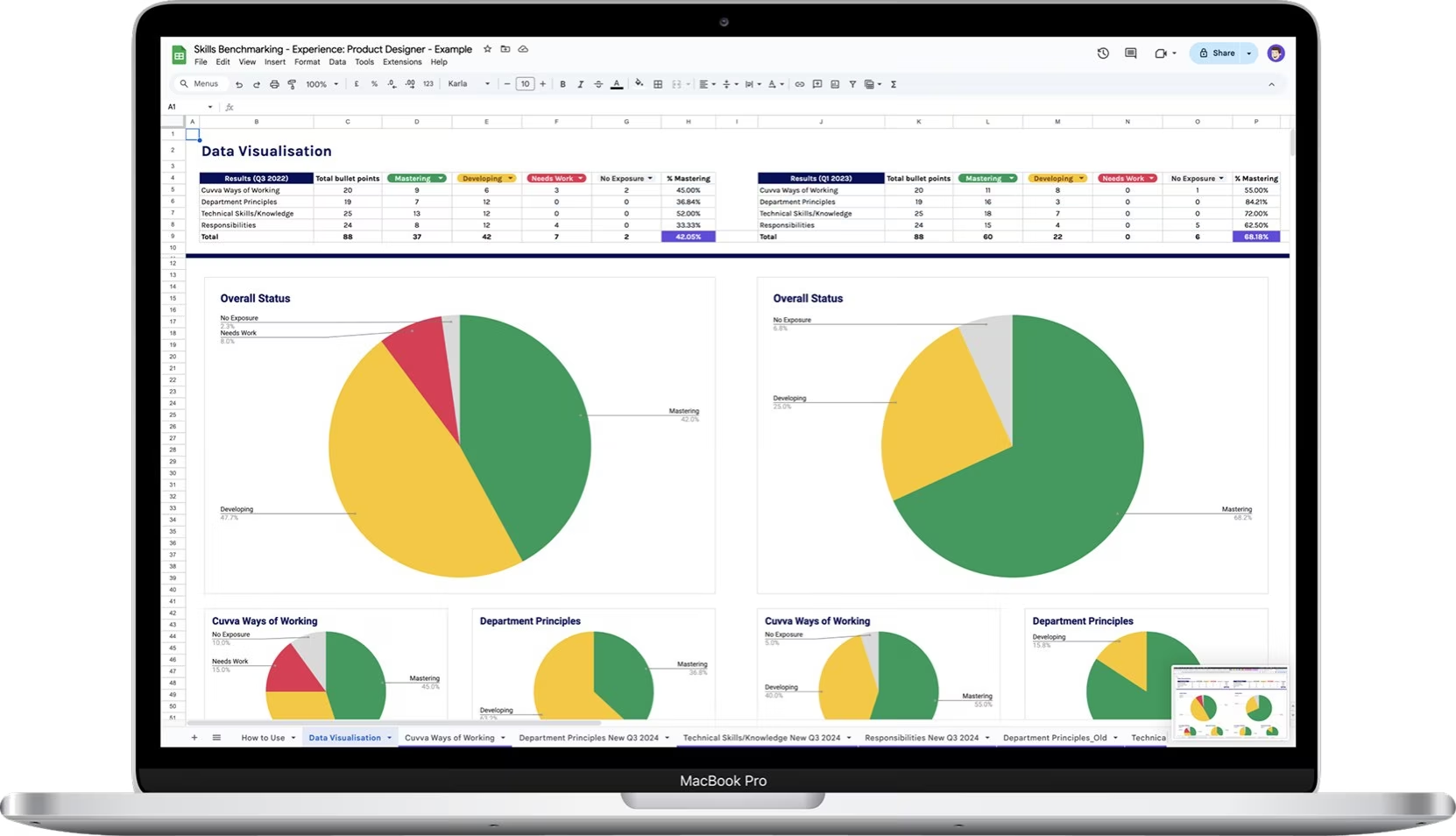
- 90% of staff adopted the Google Sheets tool, making it the go-to for evaluations.
- Around 24 hours saved per person each year, the equivalent of one full-time role.
- People use it as a “brag doc” to keep track of their development areas.
- Team members have been promoted and moved up salary bands.
- More comprehensive job descriptions led to higher design salaries across the board.
Reflections
The framework made a positive impact, but it isn’t without its challenges, and there are definitely areas to improve.
As Cuvva matured, job descriptions became more comprehensive, adding new skills and responsibilities, and some roles changed what they were expected to deliver. That meant regular updates to the evaluation sheets, which got complex when adding and removing items for automated scoring.
Scoring people against both their current role and their next one can also be tricky. Looking back, a dedicated tool like Progression might have simplified things, even at a cost.
I also spent a lot of time detailing the framework for junior and associate-level roles. Given our hiring needs at the time, that probably wasn’t the best use of my time.